Pitaka
Local-First Personal Finance Tracker for Filipinos

The Challenge
Most financial apps require users to link sensitive banking credentials to third-party cloud servers or inundate users with ads and subscriptions. Filipinos needed a secure way to reconcile GCash, Maya, SeaBank, and traditional bank balances with zero privacy trade-offs.
How It Was Solved
Engineered a local-first mobile client using Flutter and SQLite. State management is powered by Riverpod, ensuring asynchronous reactive UI updates with zero cloud dependencies or user tracking.
System Architecture & Data Flow
Local-First Reactive State Architecture
Zero network egress: client data remains entirely encapsulated on the local device filesystem with encryption.
Presentation Layer
Flutter widget tree with native adaptive design tokens and fluid gesture support.
Reactive State Controller
Riverpod providers orchestrating asynchronous financial computations and currency conversions.
Data Access Object (DAO)
Abstraction layer shielding repository queries and maintaining referential integrity across ledger items.
Persistent Engine
Embedded on-device SQLite database with write-ahead logging (WAL) for microsecond query speeds.
Key Features & Engineering Highlights
Philippine Banking & E-Wallet Tailoring
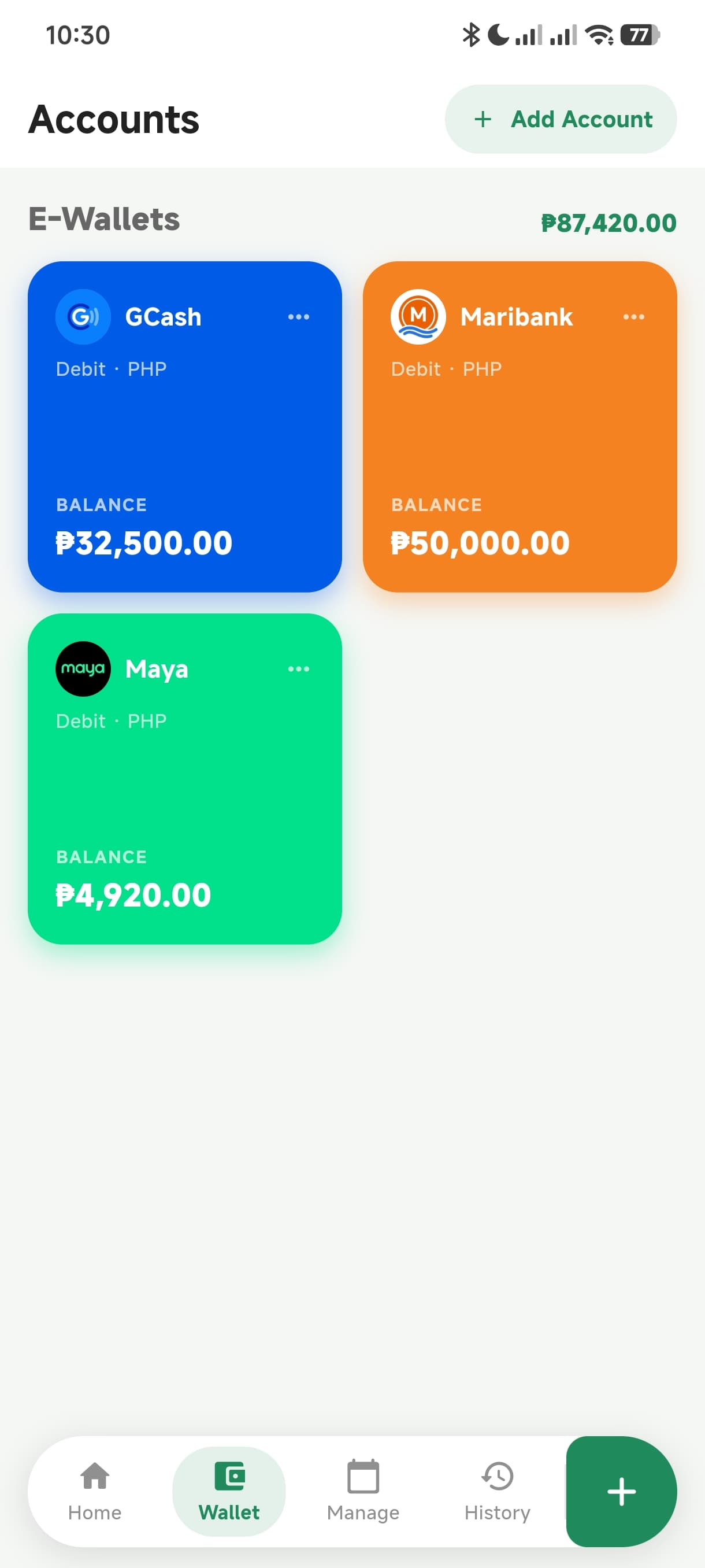
Pre-configured metadata, fee schemas, and color-coded presets for GCash, Maya, BPI, BDO, UnionBank, and Gotyme.
Zero Cloud / Zero Analytics Tracking
No telemetry, no remote servers, no account registration. All transactions remain strictly on the user's hardware.
Multi-Currency Ledger & Instant Reconciliation
High-precision integer-based balance arithmetic preventing IEEE 754 floating point calculation inaccuracies.
Architectural Trade-offs & Decisions
Decision 1: Local SQLite Database over Cloud BaaS (Firebase/Supabase)
Personal finance data is extremely sensitive; local-first architecture offers immutable user trust and offline resilience anywhere in the country.
Cross-device synchronization requires manual user-initiated file backups rather than automatic cloud replication.
Decision 2: Riverpod Code Generation over Vanilla Provider
Compile-time safety for provider dependencies, preventing runtime provider not found exceptions and optimizing rebuild trees.
Requires running build_runner during development cycles.
Measurable Outcomes & Production Impact
- ✓100% offline capability with zero latency on balance calculations.
- ✓Over 0kb of user data sent to external servers, delivering true privacy.
- ✓Open source codebase published on GitHub for community auditing.